Thin Wires, Thick Confidence: What Drone Sensors Still Can't Spot Over a British Back Garden

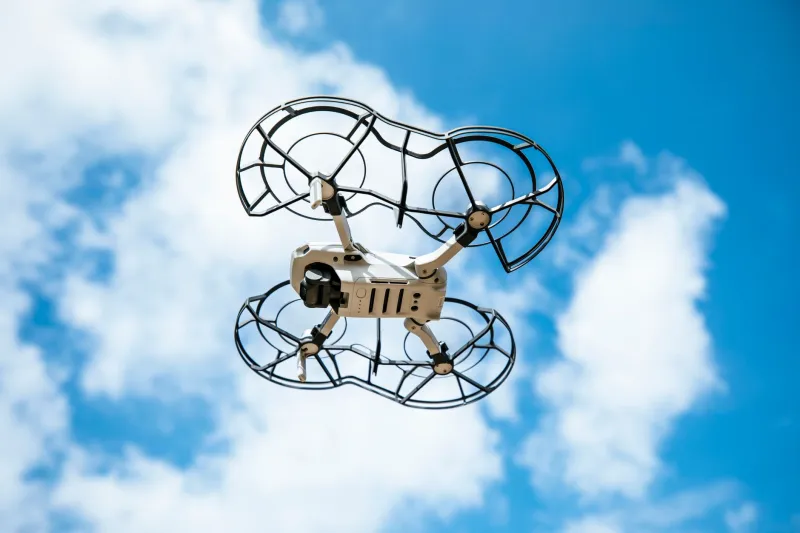
Photo by Photo by Pamela Hallam on Unsplash on Unsplash
Sensing is the feature that sells drones in 2026. Look at any box in a UK retailer and you'll find a diagram of overlapping cones, arrows pointing forwards, backwards and down, and a reassuring phrase about obstacle detection. What the diagram never shows is a 6 mm catenary wire strung between two telegraph poles at the end of a Victorian terrace — the sort of thing that hangs there, unnoticed, until a propeller finds it.
None of this means the sensors are bad. It means they are narrow specialists, and buying as though they are general-purpose insurance is how people end up posting teary photos of a cracked gimbal on a Sunday evening.
Thin wires are a physics problem, not a software one
Obstacle sensing on consumer drones overwhelmingly relies on vision or on short-range time-of-flight and infrared. Both need something to bounce off or something to recognise. A pylon conductor, a BT drop wire or the cord of a rotary dryer presents a cross-section measured in millimetres, often against a bright, flat sky. The detector sees a few pixels at best, and those pixels are low-contrast against the background.
Add a sagging line — and British overhead lines sag generously in summer — and you add a second problem: the wire may sit outside the sensor's cone for most of your approach. By the time it would enter the detection volume, a drone travelling at 8–10 m/s needs several metres to arrest its momentum. Detection and avoidance are two different jobs, and only one of them happens instantly.
Market a system as omnidirectional and buyers hear "sees everything". The honest reading is "covers more of the sphere, with the same physics limits inside it".
What each sensing direction actually buys you
Forward and upward sensing is the strongest of the three on most current models, and it is genuinely useful against walls, hedges, parked vans and the overhanging canopy of a mature oak. It's weakest in low sun, against a featureless sky, and when a branch tapers to twigs.
Downward vision and infrared help with landing and with holding position, and they'll resist an unplanned descent onto a garden bench. They're noticeably less reliable over water, over a dark tarmac drive in winter, and at dusk when the texture they rely on fades.
Lateral and rear coverage, now appearing on sub-250 g models as well as larger aircraft, is the newest and the most oversold. It fills gaps, which is a real improvement — but the sensors still won't reliably catch a slim fence post you drift into sideways while framing a shot.
Three test cases from an ordinary garden
The fence post. A 7 cm post at the boundary is well within the detection envelope in daylight. So why do people hit them? Because they meet it while yawing, at close range, with the camera pointed away from the flight path. The sensor takes the shortest possible look at a small object, and the pilot's attention is on the screen.
The low branch. A trunk reads clearly. A branch with a 3 cm diameter and a handful of leaves reads as background clutter and then, briefly, as nothing. Descending past a birch or a leylandii is one of the least forgiving manoeuvres in the hobby.
The wire. A phone line to the house, a washing line, a set of fairy lights zip-tied along a fence — all sit in the same category: thin, low-contrast, and easy to lose against the sky. These are the ones that matter in a suburban flight, and they're the ones the brochure diagram will never draw.
False confidence is the real cost
The dangerous part of obstacle sensing isn't the failure itself. It's the behaviour it encourages — flying a metre lower than you would otherwise, skimming a boundary you'd normally keep clear of, trusting the aircraft to bail you out while you look at the histogram.
UK rules don't shift either. Whether you're flying under the Open Category with an operator ID, or just pottering a sub-250 g drone in the garden under the Dronecode, staying clear of people and property and keeping the aircraft in sight remains your job. Sensors are assistance. Nothing on the box transfers the responsibility.
The two-minute scan that costs nothing
Before you take off, stand at the launch point and run three sweeps. It takes less time than a battery check.
- Eye level, full 360. Fences, bins, patio heaters, trampolines, goalposts, satellite dishes, gutters, conservatory roofs. Say each one out loud if you're new to the spot — naming fixes location in your head.
- Up 30 degrees and around. Pylons, telegraph poles, street lamps, and every wire that joins them. Look for service drops from the pole to the house, and for anything crossing the open patch of sky you intend to use.
- Down and out. Which part of the lawn or patio is your emergency landing zone? Where would a failsafe return bring the drone if it lost signal behind the house?
Then apply what I call the gap test: if a wire, branch or cable crosses the airspace you planned to use, change the plan rather than the altitude. A flight path that avoids the question entirely beats a clever workaround.
Buy for the pilot, not the diagram
When you're comparing models in 2026, treat sensing as a tie-breaker rather than a headline. It earns its keep on the forward axis, in good light, at moderate speed, and it will save you from a hedge more than once. It will not reliably save you from a washing line.
What genuinely improves your odds is boring: prop guards on a first aircraft, a launch spot with a clean overhead view, a conservative altitude on unfamiliar ground, and the habit of pausing to look up before every take-off. Sensors watch one or two metres of air. Your eyes cover the whole garden — and, unlike the drone, they know where the wires are.